Time limits, more officers and new signs all help. Here is why the improvement rarely lasts.
Most airports have already tried to fix the curb. Time limits were posted. Officers were added, or moved to the peak. Signs were replaced. A staging lot was opened for commercial vehicles. In some cases a fee was introduced or raised.
Each step helped. In many cases, the improvement faded. That pattern is worth understanding. It is rarely a lack of effort. It usually comes from fixing the curb without knowing which problem the curb actually has.
What actually causes airport curbside congestion?
Congestion is a symptom with several unrelated causes. Each one responds to a different fix.
Overstays. Cars waiting well past the posted limit for a passenger. The most visible cause, and the one most fixes target.
Double-parking. Drivers stopping in the travel lane because the curb lane is full. This turns a space problem into a flow problem. A handful of double-parked cars can delay everyone behind them.
Recirculation. Drivers who cannot stop on the first pass loop around and come back. These cars use road capacity without serving anyone. Most airports have no data on them at all, because nothing counts repeat passes.
Zone drift. Activity moving away from where policy says it should be. Commercial pickups in private lanes. Arrivals traffic moving up to departures. Drivers stopping wherever they can.
Private vehicles. At many airports, a large share of curb activity is friends and family. They face time limits but not permits or fees. So measures aimed at commercial operators only address part of the problem.
Add officers when your real problem is recirculation, and you get a small improvement and a frontage that still fails at 5pm.
Is average dwell time a useful measure?
Where airports do measure the curb, the headline number is usually average dwell. It is the least useful number available.
An average of four minutes can describe a curb where almost every car leaves quickly and a few sit for twenty minutes. It can equally describe a curb where most cars sit for four minutes and nothing goes over six.
Those are different problems. The average hides which one you have.
Congestion comes from the long stays, not the average. Sacramento International Airport shows this well. After camera-based curbside monitoring went in, the share of vehicles staying under the four-minute limit rose from about 60% to 89%. In other words, overstays dropped from roughly 40% of vehicles to about 11%.
The airport’s result was in the long tail. That is where congestion lives.
Why doesn’t adding more officers fix the curb?
Officers on a patrol loop arrive after the event. The math is unforgiving.
A loop across several terminals takes time to complete. At a large hub, that lap can easily take longer than a violation lasts. A car arrives, loads, sits several minutes past the limit and leaves — all within one lap.
Adding officers shortens the lap. It does not change how the lap works. And it scales in a straight line against a problem that concentrates into a few hours of a few days.
Radio coordination makes it harder. Information arrives as speech, with no evidence attached. The officer who responds has to work out what happened after the fact. That makes the conversation longer and the outcome easier to argue with.
Does curb pricing actually reduce congestion?
This is why improvements fade.
Cars priced or enforced away from the inner curb do not leave the airport. They show up on the outer curb, on the departures level, or in the loop. Pickup activity moving from arrivals up to departures is one of the most common and least expected results of tightening the arrivals curb.
Pricing does this on purpose. When the Los Angeles Board of Airport Commissioners raised the LAX central terminal rideshare fee from $4 to $12 in March 2026, it set a $6 rate at the Ground Transport Center at the same time. The gap between the two prices is the tool. It is designed to move trips — and wherever those trips go needs the space, staging and shuttle frequency to take them.
Measure only the zone you changed and you will record a success. Measure the whole frontage and you will see where the traffic went.
Telling drivers works, and it is usually what is missing
A posted time limit gives the driver no feedback. They cannot see how long they have been stopped. Nothing warns them they are close to the limit until an officer appears.
Driver-facing displays close that gap. A sign showing the limit and a live countdown lets drivers move on before enforcement is needed. That is cheaper and far less confrontational.
Prevention also scales in a way enforcement cannot. A sign works on every vehicle at once. An officer works on one.
How long should an airport measure before changing anything?
Airports that measure before changing anything are often surprised.
The peak is at a different hour than assumed. Overstays sit in one or two lanes, not across the whole frontage. A vehicle type nobody watched turns out to cause a large share of the long stays. Recirculation, once counted, is bigger than anyone thought.
None of that shows up in complaints or ticket counts, which are the two things most airports rely on. Both arrive late, and neither describes the curb.
A few weeks of measurement, with no change to enforcement, costs very little. It usually reorders the priority list before a single policy changes.
How SenSen approaches curbside congestion
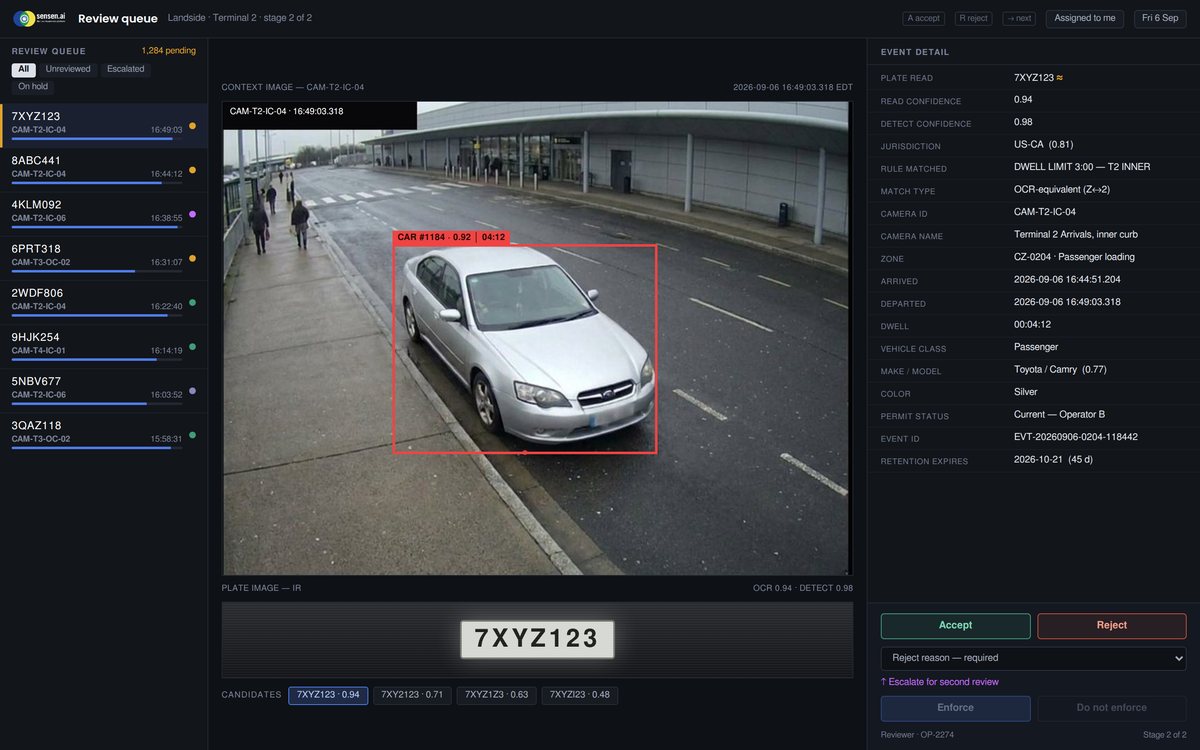
SenSen’s airport landside operations platform measures dwell from arrival to departure. It tracks lane occupancy, turnover and vehicle type by zone. And it spots repeat passes, so recirculation becomes a number instead of a guess.
Violations can go to officers in real time, with the plate read, images, vehicle type and elapsed dwell attached. Patrols become directed instead of random.
Driver-facing E-Ink signs show the posted limit and a live countdown at the curb, clearing some overstays before an officer is involved.
It runs on existing camera feeds, portable units or pole-insertable devices, installing in under thirty minutes without trenching or lane closures.
Find out which problem you have first
Curbside congestion comes back at well-run airports because the fixes are sound and the diagnosis is missing. Time limits, officers, signs, staging and pricing all work — on the specific problem each one is built for.
Measure one frontage for a few weeks and change nothing. What comes back will tell you which of the five problems you have, and how much of your congestion is behavior rather than a shortage of space.
That is worth knowing before any capital conversation. It is also the only reliable way to make the next fix stick.
Frequently asked questions
What causes airport curbside congestion?
At least five separate things: vehicles overstaying the posted limit, double-parking in the travel lane, drivers recirculating when they cannot stop, activity drifting outside designated zones, and private vehicles that face time limits but no permits or fees. Each responds to a different fix.
Is average dwell time a useful measure of curbside performance?
Not on its own. An average of four minutes can describe a curb where almost every vehicle leaves quickly with a few staying twenty minutes, or one where most stay four minutes and none exceed six. Congestion comes from the long stays, so the distribution matters more than the mean.
Why doesn’t adding more officers fix curbside congestion?
Officers on a patrol loop arrive after the event. At a large hub a full lap can take longer than a violation lasts, so a vehicle can arrive, overstay and leave within one lap. More officers shorten the lap without changing how it works.
Does curb pricing reduce airport congestion?
It moves demand rather than removing it. LAX approved a $12 central terminal rideshare fee and a $6 rate at its Ground Transport Center in March 2026; the gap between the two prices is the instrument. Displaced vehicles reappear elsewhere, so measuring the whole frontage matters.
How long should an airport measure the curb before making changes?
A few weeks of measurement with no change to enforcement is usually enough. Airports commonly find the peak is at a different hour than assumed, that overstays sit in one or two lanes, or that recirculation is larger than expected. That baseline reorders the priority list.
Take the next step
Download the four-page airport landside brief — what the platform sees on day one, and what it can automate later.
Talk to our airport team about measuring one terminal frontage.
Sources
- Sacramento International Airport curbside monitoring results — GovTech
- LAX ground transportation fee decision, 10 March 2026 — Los Angeles World Airports