Continuous curb enforcement, real-time curb data, and court-ready evidence, from a pole-inserted solar and battery camera a city can install in 30 minutes.
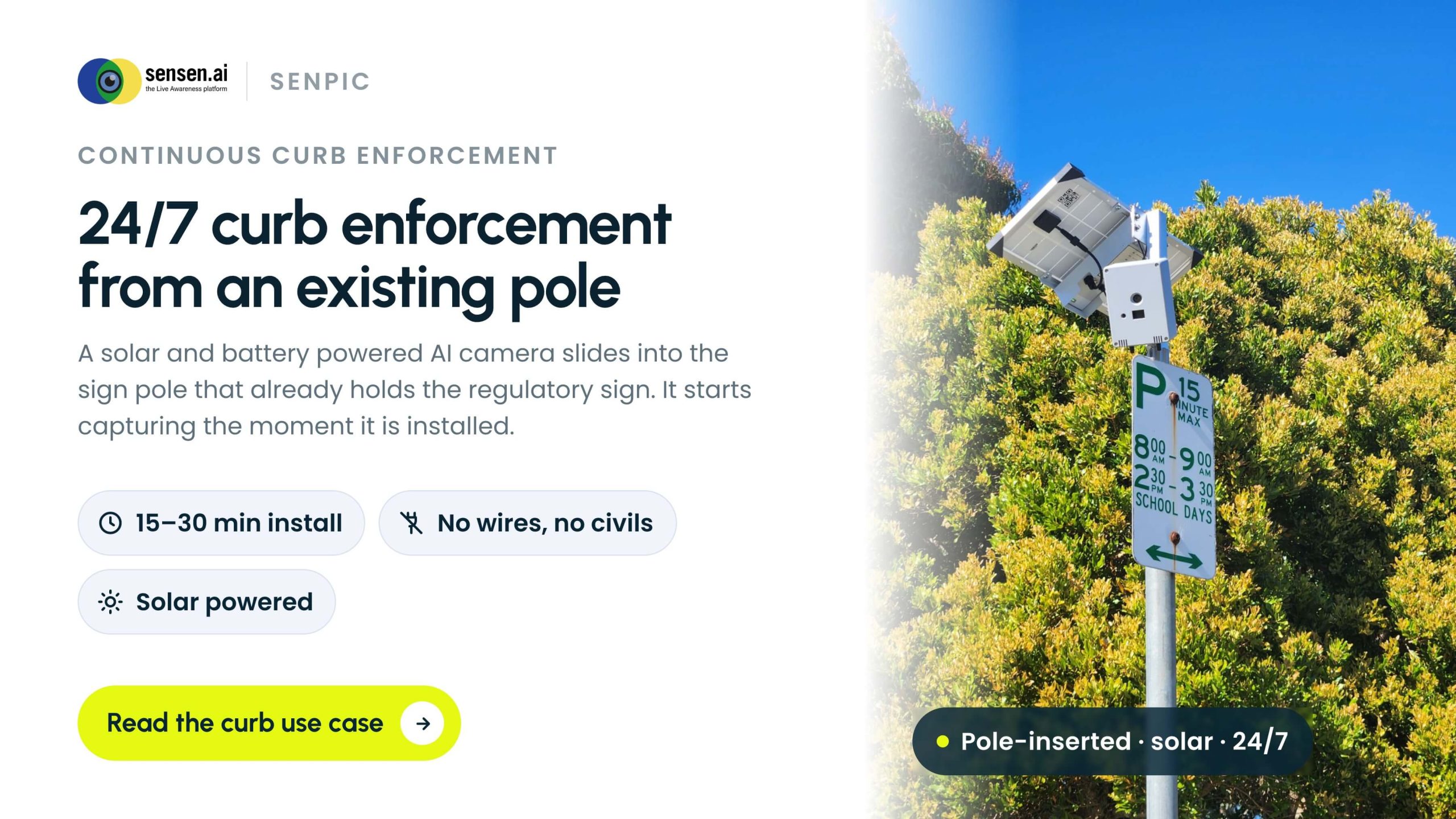
Most cities can only enforce a fraction of the curb with the team they have. SenPIC changes that. It turns an existing parking pole into a continuous enforcement and curb-data sensor. A self-contained solar-powered AI camera slides into the standard sign pole that already holds the regulatory sign. No wires. No electrical work. No connectivity buildout. The unit starts capturing the moment it is installed, and a city’s own field crew can do the install in 15 to 30 minutes.
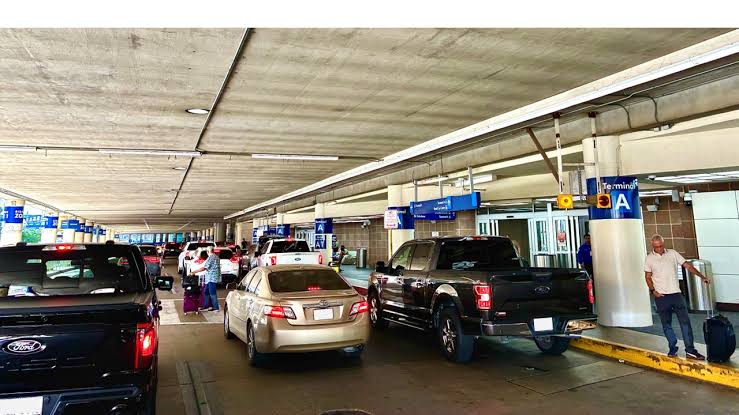
That changes what a city can enforce, and how fast it can scale it. Continuous coverage of bus stops, taxi zones, loading bays, accessible spaces, EV bays, and school zones, on the corridors where patrols can never sit, becomes a one-pole-at-a-time decision rather than a capital project. And every SenPIC on the network feeds a real-time curb-data layer the city can use for planning, pricing, and policy.
This article is a working primer on what SenPIC enables. What it sees and when. How it handles complex multi-rule signs. How privacy is built in. What workflow it supports for ticket-by-mail and existing citation systems. Where it fits alongside SenFORCE Mobile patrol enforcement.
What is SenPIC?
SenPIC is a pole-insertable, solar and battery powered AI camera system for continuous curb enforcement and occupancy intelligence. It is hardware-light by design: no local AI, no mains power, no cabling. All processing runs in the cloud through SenSen’s central back-office SenBOS. The field hardware stays simple, and the intelligence improves centrally without anyone touching a pole.
Each unit comes in a 1-camera or 2-camera configuration. The two-camera version is the workhorse for bi-directional curb segments, where each camera can enforce a different rule set on the same pole, powered by a single solar panel or damage proof battery unit. The one-camera version suits single-direction streets and lower-density sites.
Why is continuous curb enforcement so hard for most cities today?
Three structural constraints have kept continuous curb enforcement out of reach for most cities. Officers cannot be everywhere; patrols cover a slice of the network and rotate through the rest. Fixed sensors and hard-wired cameras require civil works, electrical, and connectivity, each of which carries cost, delay, and permitting overhead. And the static cameras that do exist are usually tied to a single rule on a single block, so they do not scale across the city.
The result is the model most parking directors describe: a patrol-led program that catches part of what is happening at the curb, with no continuous picture of the rest. SenPIC removes those constraints directly. The pole already exists. The sign already exists. The camera clips onto the pole, runs on the sun, and starts working the moment it is installed.
How does SenPIC install on an existing street pole?
In 15 to 30 minutes, by one person, with no contractor required. SenPIC is designed to fit the standard sign pole that already holds the regulatory parking sign. The installer pops the cap off the top of the pole, slides the SenPIC unit in, and secures it. There is no cabling to run, no power to provision, and no junction box. Connectivity is cellular or Wi-Fi, configured at provisioning.
City teams are doing their own installs. Public-works crews and parking operations teams put these in across the network without waiting for a SenSen contractor. The footprint is low: the solar panel is roughly the size of the regulatory sign, with the camera and panel sitting just above the sign head. On one recent site walk, the head of a city’s parking team walked the corridor and asked where the cameras were. He could not see them until he was told where to look. That is the design intent.
What does SenPIC capture, and when can it issue a citation?
SenPIC captures continuously, by default the unit captures on a fixed cadence. The cameras include a night mode. Effective range at night is shorter than during the day, which is the physics of the sensor, but cities are issuing citations with SenPIC up until 1 a.m. in production today. Every event captures the vehicle, the location, the time, duration of dwell which sharply reduces false positives before a human ever sees them.
Can SenPIC handle complex multi-rule parking signs?
Yes. SenPIC is rules-aware, not just plate-aware. The system enforces any rule defined, including the multi-line, time-of-day-staggered signs that downtown corridors are known for. One pole can carry one rule set in one direction and a different rule set in the other, and a single 2-camera SenPIC handles both. That is how a single pole enforces, for example, a paid 2-hour bay in one direction and a no-stopping clearway in the other, on the same street segment, at the same time of day.
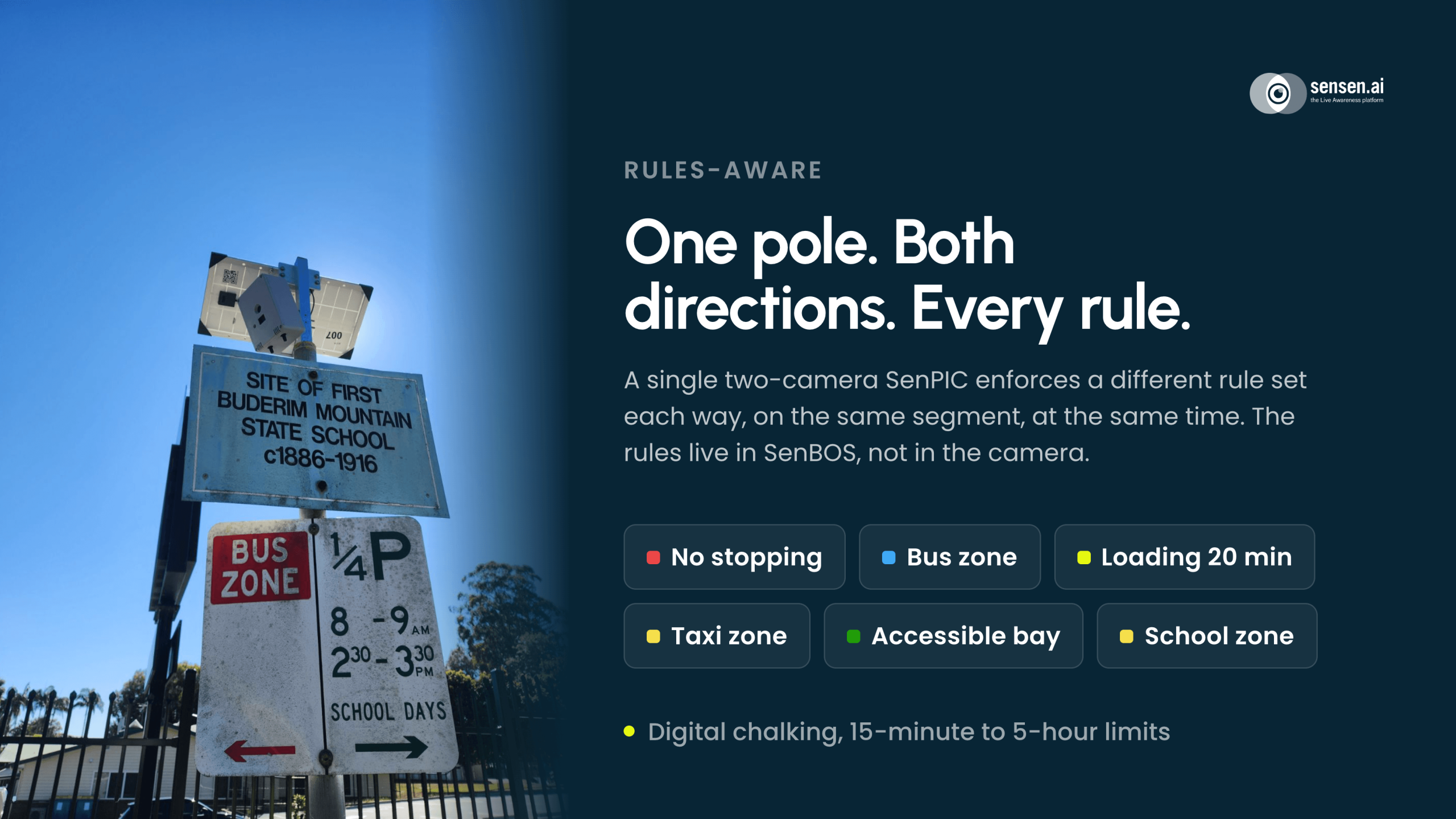
The rule library is broad. Today, SenSen-powered programs enforce time-limit overstays (15-minute through 5-hour) with digital chalking; residential, visitor, and accessibility permits; no-stopping signs and continuous yellow edge lines; bus zones, bus stops, taxi zones, and loading zones with differentiated dwell limits (2-, 20-, and 30-minute commercial-vs-passenger variants); mail zones, works zones, truck zones, shared and safety zones; bus, transit, truck, and bicycle lanes; intersection setbacks and crosswalk approaches; footpath, nature-strip, and driveway clearances; fire-hydrant and postbox offsets; bay-position and orientation rules; heavy-vehicle dwell limits; school-zone variants tied to school times; EV-bay enforcement; and even littering and dumping from vehicles. The same rule set is available to SenPIC because the rules live in our proprietary back-office, not in the camera like other solutions.
How is privacy handled in SenPIC evidence?
Privacy is enforced at source. SenPIC blurs faces and pedestrian bodies in every captured image, so anyone walking past the unit is not identifiable in the evidence package. License plates of compliant vehicles, the ones that did not break the rule, are also blurred automatically. Only the vehicle attached to the citation is identifiable.
That design has a practical consequence: the captured images are safe to publish. Cities can include the evidence images on the mailed citation and in the resident-facing portal where the recipient reviews the case, without manual redaction in the back office. The privacy treatment is built into the pipeline, so the images that arrive are already cleared for resident-facing use.
What workflow does SenPIC support for ticket-by-mail and integrations?
A trained officer reviews each alert in SenBOS before it becomes a citation. The interface shows the captured evidence, the matched zone, and the rule, with simple visual cues. A stop in a bus zone shows as blue. A no-stopping breach shows as red. The officer accepts or rejects the alert. Accepted alerts route to the city’s existing citation workflow, including ticket-by-mail.
SenPIC integrates with the systems cities already run. Integrations include the 200+ major parking ecosytem partners with several trial integrations underway for additional handheld and back-office platforms. For cities already issuing some citations by mail (often because patrol officers take photos in the field and pass them to the back office), SenPIC plugs into that pipeline rather than replacing it.
What does SenPIC unlock beyond enforcement?
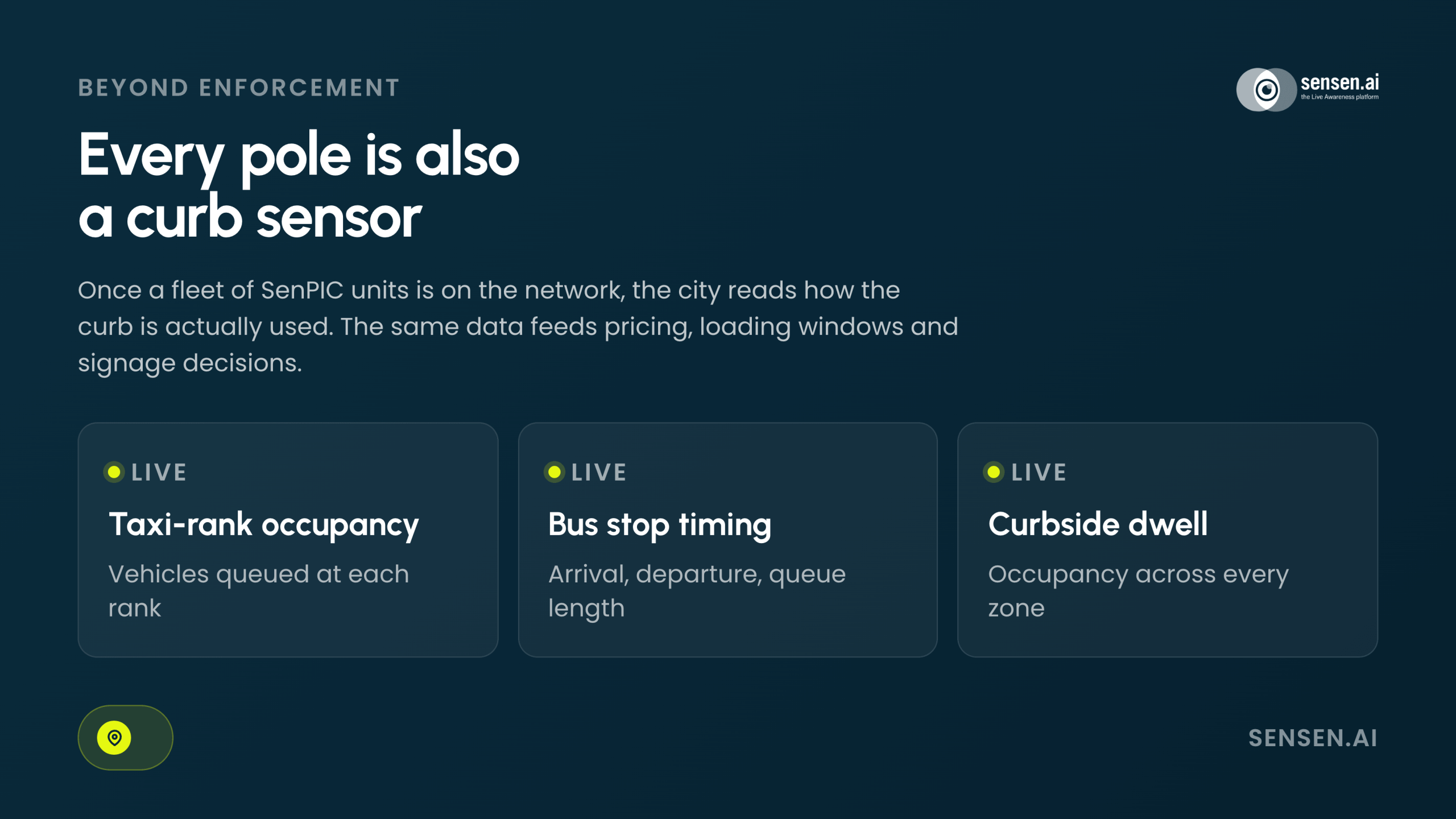
A continuous curb camera is also a continuous curb sensor. Once a fleet of SenPIC units is on the network, a city has a real-time picture of how the curb is actually being used. That picture is useful long after the citation question is closed.
Live SenPIC analytics include real-time taxi-rank occupancy (how many vehicles are queued at each rank, at any moment), bus arrival and departure timing at stops, passenger queue lengths, and aggregated curbside occupancy and dwell across all monitored zones. That data feeds policy decisions: which loading windows are the right length, where the city should adjust paid-parking pricing, which corridors need redesigned signage, and where dwell patterns are masking a deeper compliance issue. The Dynamic Curbside program runs SenPIC alongside a broader curb-analytics layer that turns each unit into both an enforcement and a planning asset.
Where does SenPIC fit alongside Mobile LPR?
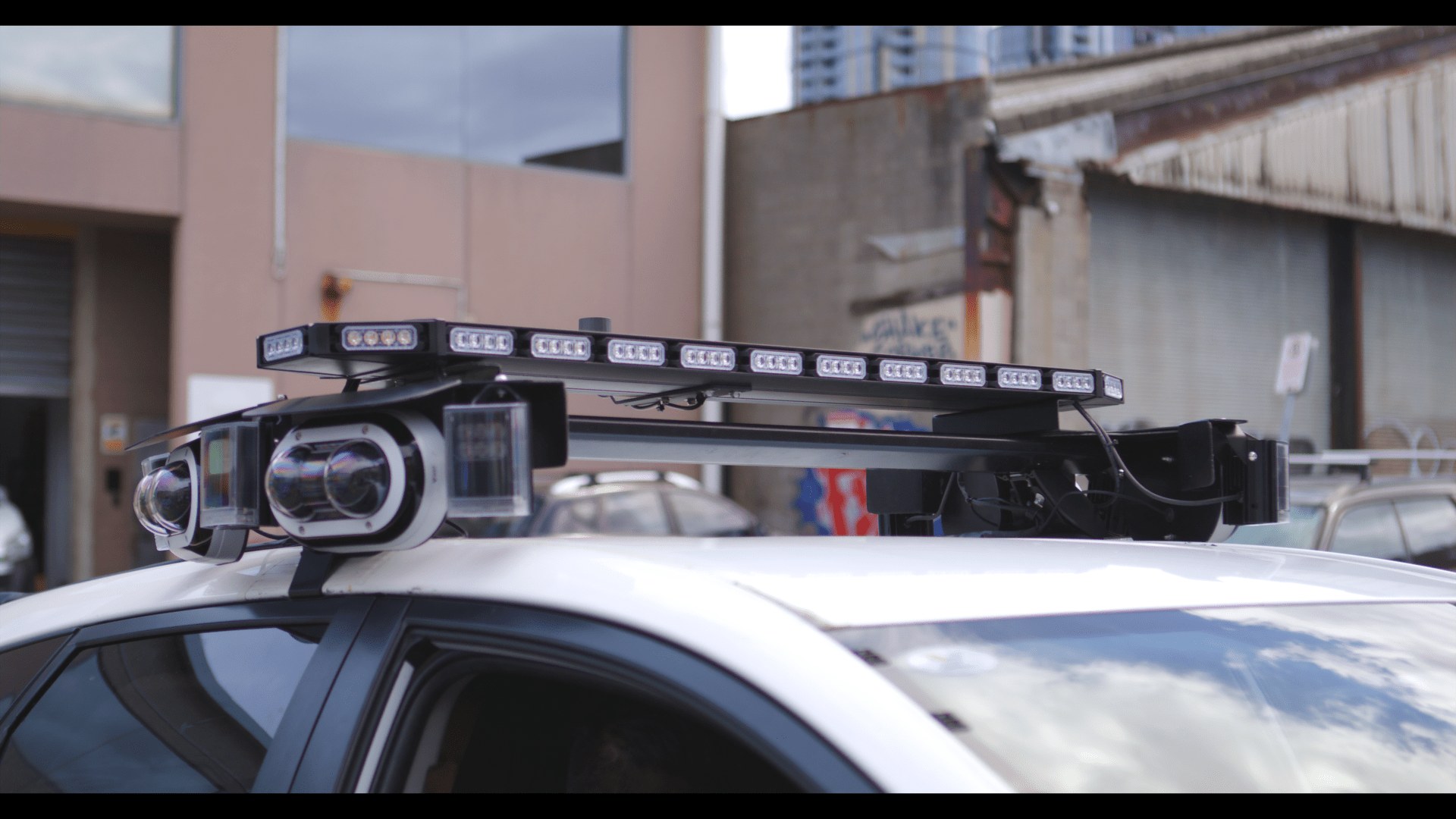
Both are complementary, not competitors inside the SenSen portfolio. SenFORCE Mobile is the vehicle-mounted product that delivers city-wide patrol enforcement at speed, scanning hundreds of plates per hour across a regulated network. SenPIC is the portable, self-powered product that delivers 24/7 enforcement on chosen corridors and hot spots, with no civils.
Most cities run them together. SenFORCE covers the broad network on a patrol cadence. SenPIC stays on the curb segments where continuous presence matters: smart loading zones, accessibility bays, bus stops, taxi ranks, school zones, EV charging bays, and the chronic problem spots where patrol-by-patrol enforcement was never going to keep up. Both products feed the same SenBOS back office, so the city’s enforcement picture is unified rather than scattered across two systems.
How do cities typically roll out SenPIC?
The pattern is to start with one high-impact category, prove the result on a handful of units, and scale to dozens or hundreds across the network. Smart loading zones, taxi ranks, bus stops, school zones, and EV charging bays are the common first picks because each one delivers an obvious operational unlock from the first installed unit. Cities are ordering SenPIC in hundreds-of-units quantities once the model is proven on the first corridor.
Cities run SenPIC as part of its broader curb-intelligence layer, which combines continuous enforcement with real-time occupancy and behavior analytics. The next generation of the platform, SenPIC 4.0, adds a battery-pack option for curb segments where solar is not viable, which extends the deployable surface area across downtown shaded corridors and underground-adjacent zones. SenSen expects to be talking with cities about v4 through 2026-27.
Where does this go next for cities?
The headline shift is what a city can now enforce continuously. Patrol vehicles will always do the city-wide sweeping work. SenPIC is what enforces the corridors and hot spots that patrols can never sit on, the segments where 24/7 presence is the only thing that drives compliance. Once those are on, the city also has a real-time curb-data layer it can use for planning, pricing, design, and policy.
For a parking director evaluating curb digitization today, the question is not whether the technology works. It is which curb segment, which rule type, will release the most operational capacity in the first 90 days. Pick that. Install one pole. Then the next ten. Then scale across the network.
See how SenPIC enforces a curb segment continuously, with court-ready evidence and built-in privacy. Read the curb enforcement use case or talk to our team.
Frequently asked questions
What is SenPIC?
SenPIC is a pole-insertable, solar and battery powered AI camera system for continuous curb parking enforcement and occupancy analytics. There is no local AI on the device; all processing runs in the cloud through SenSen’s central back-office platform.
Is SenPIC mains-powered?
No. SenPIC runs on solar power, with a battery-pack option coming in SenPIC v4 for curb segments where solar is not viable. The unit requires no mains power, no cabling, and no civil works.
How long does a SenPIC install take?
Fifteen to thirty minutes for one person, using the existing parking sign pole. The installer pops the cap off the pole, slides the unit in, and secures it. The device authenticates to the cloud at first capture.
Can SenPIC enforce in both directions on the same pole?
Yes. The 2-camera configuration runs a different rule set per direction, powered by a single solar panel.
What rules can SenPIC enforce?
Any rule definable in the city, including time-limited paid parking, residential and accessibility permits, no-stopping and no-parking zones, bus/taxi/loading zones with differentiated dwell, bus and bike lanes, school-zone variants, EV-bay rules, intersection and crosswalk setbacks, and more.
How is privacy protected in SenPIC images?
Faces and pedestrian bodies are blurred at source. License plates of compliant vehicles are blurred automatically. Only the vehicle attached to the citation is identifiable, which is what makes the images safe to publish on the mailed citation and in resident-facing portals.
Does SenPIC work at night?
Yes. The cameras include a night mode. Effective range is shorter than during the day, but cities are issuing citations with SenPIC up until 1 a.m. in production today.
How does SenPIC compare to Mobile LPR?
SenFORCE Mobile is the SenSen’s vehicle-mounted patrol product that delivers city-wide enforcement at scanning speed. SenPIC is the portable, self-powered product that delivers continuous enforcement on chosen curb segments. Most cities run them together, feeding a single SenBOS back office.