
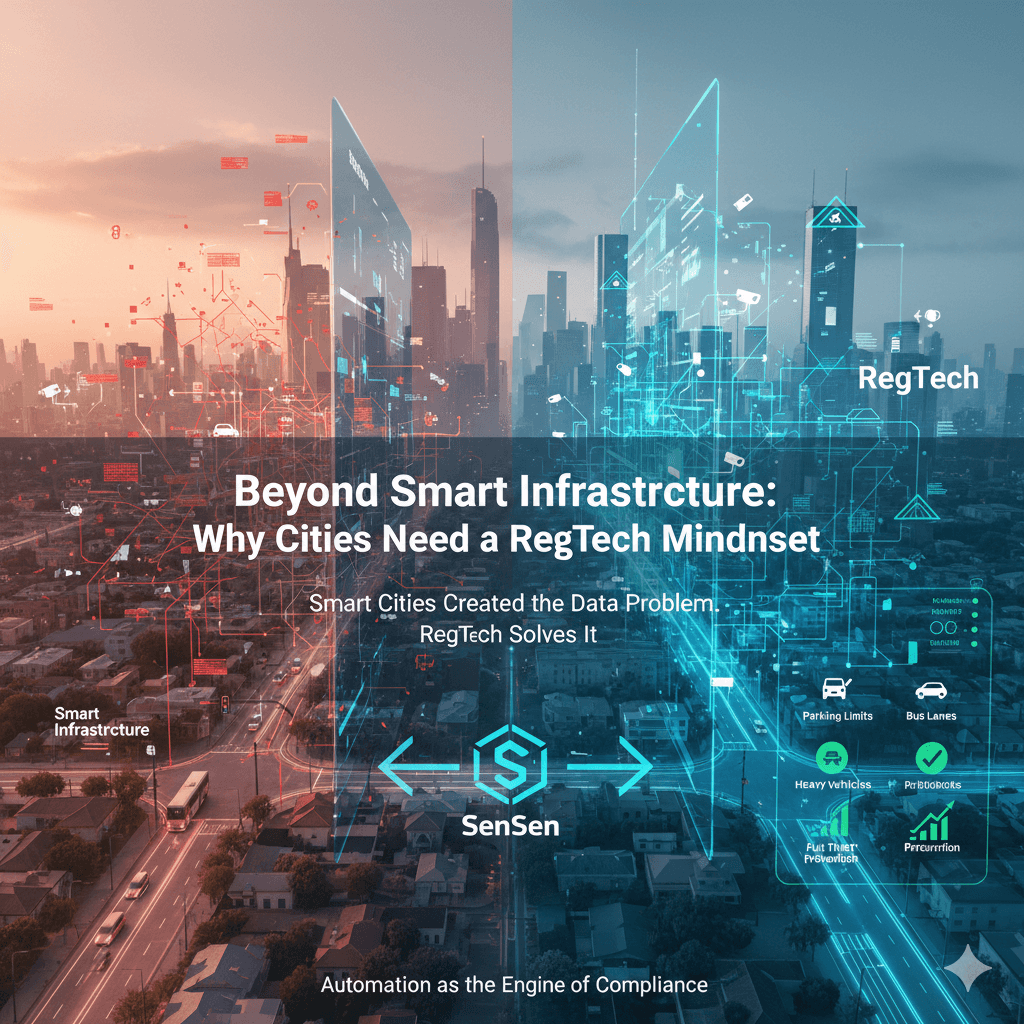
RegTech, short for regulatory technology, is the discipline of turning compliance from a manual, reactive burden into an automated, defensible, scalable capability. Finance adopted it years ago to keep pace with obligations that grew faster than the teams managing them. Cities now face the same gap, and RegTech is the mindset that closes it. The smart-city promise was efficiency. What many councils and agencies actually received was complexity: more sensors, more cameras, more connected systems, and more data than ever, without the tools to turn any of it into clear, consistent action on the ground.
The missing piece is not more infrastructure. Cameras, connected vehicles, digital permits and kerbside sensors are already in place across most cities. The missing piece is intelligence: the ability to monitor obligations continuously, act on what the data shows, and stand behind every decision. That is what a RegTech mindset delivers, and it is what SenSen brings to parking, public safety, ports and transit using the camera infrastructure a city already owns.
What is RegTech and why does it matter for cities?
RegTech is technology that makes regulatory compliance automated, consistent and evidence-backed. In finance it monitors transactions against rules in real time, flags what needs attention, and keeps a defensible record of every judgement. The value is not speed alone. It is the ability to apply the same standard everywhere, prove it, and scale it without adding headcount for every new obligation.
Cities carry a comparable load. A local government enforces hundreds of by-laws, manages kerbside and parking rules, maintains road and footpath assets to a standard, and keeps public spaces safe. Each of those is a compliance task. Historically each has been handled by hand, in isolation, and at a pace set by how many people are available. A RegTech mindset reframes the work: compliance becomes a continuous, monitored function rather than an occasional patrol or a periodic audit. The obligation is always watched, the response is consistent, and the record is always there.
Why has smart infrastructure not solved the problem?
Smart infrastructure was sold as the answer, and in one sense it delivered. Cities are better instrumented than at any point in their history. The problem is that instrumentation and intelligence are not the same thing. A camera that records is not a camera that understands. A permit system that stores data is not a system that tells an officer where to act next. Most cities have accumulated the sensing layer and stopped short of the reasoning layer that would make it useful.
The result is a familiar frustration. Councils have more data than ever but not more clarity. Footage sits unwatched. Reports describe what happened last month rather than what needs attention today. Teams spend their time gathering and reconciling information instead of acting on it. The infrastructure works exactly as built. It was simply never given the intelligence to convert observation into defensible action.
How does a RegTech mindset turn data into defensible action?
The shift is from collecting data to acting on it with confidence. A RegTech approach does three things at once. It monitors continuously, so an obligation is checked against reality around the clock rather than during a single shift. It prioritises, so limited officer time goes to the cases that matter most instead of a random sweep. And it documents, so every action carries the evidence that justifies it.
Defensibility is the point that cities underrate. A decision that cannot be explained is a decision that invites dispute. When compliance is automated and evidence-backed, an officer’s judgement is supported by a consistent record: what was detected, where, when, and against which rule. That record shortens disputes, holds up to scrutiny, and lets a council apply the same standard across every street rather than street by street. Consistency itself becomes the proof that the system is fair.
What can cities do with infrastructure they already own?
The most practical part of a RegTech mindset is that it does not start with a procurement of new hardware. It starts with what is already deployed. SenSen applies AI, built on the SenDISA engine, to existing camera infrastructure, so the sensing a city has already paid for becomes an active compliance capability rather than a passive archive.
In parking and kerbside management, SenFORCE and SenPIC turn enforcement into continuous kerb intelligence, extending the reach of a single officer and surfacing where attention is needed. The Hills Shire Council used this approach across its school zones and saw heavy-vehicle complaints on the route fall from 286 to 160. In asset management, SenMAP reads roads, footpaths and signage from the same camera feeds to build a live picture of condition. Transport for NSW identified more than 54,800 road defects in a single SenMAP mobilisation across a 200 km network, and Wollongong City Council mapped a 170 km network the same way. Across public safety, ports and transit, the Intelligent Vision Agent applies the same approach to existing CCTV, camera-agnostic and privacy by design, with no facial recognition. Every one of these is the same idea: existing infrastructure, made intelligent, put to work on a compliance obligation.
How does SenSen keep this human-led?
Automated compliance is often heard as automated judgement, and that is not what a responsible RegTech approach means. SenSen is human-led by design. The technology handles what machines do well: watching continuously, detecting reliably, and assembling evidence. People handle what only people should: deciding, applying discretion, and standing behind the outcome.
The practical effect is that a smaller team covers far more ground without lowering its standard. An officer is no longer limited to what one person can physically observe in a shift. They arrive where the evidence points, with the context already prepared. This is empowerment, not replacement. The work becomes more targeted and more defensible, and the people doing it keep the authority that a city and its community expect them to hold.
Where does a city start with a RegTech approach?
The starting point is a single obligation, not a wholesale platform migration. Pick a compliance task that already generates complaints, disputes or backlog: a set of school zones, a stretch of high-demand kerb, a road network overdue for condition assessment, or a public space that needs continuous awareness. Apply intelligence to the infrastructure already covering it, and measure the change in clarity and response.
Because a RegTech approach runs on cameras a city already owns, the first deployment does not depend on a capital programme or a long rollout. It builds on what is present. From there the same approach extends across departments on one consistent model, which is the compounding advantage RegTech gave finance: one obligation proven, then the next, on shared foundations rather than a new system each time. Cities do not need to become smarter in the abstract. They need to make the infrastructure they already have accountable, defensible and continuous.
FAQ
What is RegTech for cities?
RegTech for cities is the application of regulatory-technology thinking, proven in finance, to local-government obligations. It makes compliance monitoring automated, consistent and evidence-backed across tasks such as parking, kerbside management, asset condition and public safety, so cities can act on what their data shows and defend every decision.
Do councils need to install new cameras to adopt this approach?
No. The approach is built to run on infrastructure a city already owns. SenSen applies AI to existing camera feeds, camera-agnostic, so most councils and agencies can begin without a new hardware programme. The first step activates sensing that is already in place rather than replacing it.
Does a RegTech mindset replace enforcement officers?
No. The approach is human-led. Technology handles continuous monitoring, reliable detection and evidence-gathering, while officers make the decisions and apply discretion. The result is that a smaller team covers more ground with a more defensible record, which is empowerment rather than displacement.
How is this different from smart-city infrastructure?
Smart infrastructure adds sensing: cameras, sensors and connected systems. A RegTech mindset adds intelligence on top of that sensing, turning observation into prioritised, documented, defensible action. Cities already have the infrastructure. What a RegTech approach supplies is the reasoning layer that makes it useful for compliance.
Which city functions can a RegTech approach cover?
The same approach extends across parking and kerbside management, road and asset condition, and public safety, ports and transit. SenSen delivers this through SenFORCE and SenPIC for kerbside enforcement, SenMAP for asset intelligence, and the Intelligent Vision Agent for video analytics on existing CCTV, all on one consistent, evidence-backed model.
SenSen turns the camera infrastructure a city already owns into automated, defensible, scalable compliance, the approach finance calls RegTech. Explore the SenSen platform, see how the Intelligent Vision Agent brings video analytics to existing CCTV, and look at how it works for kerbside enforcement and city asset management.