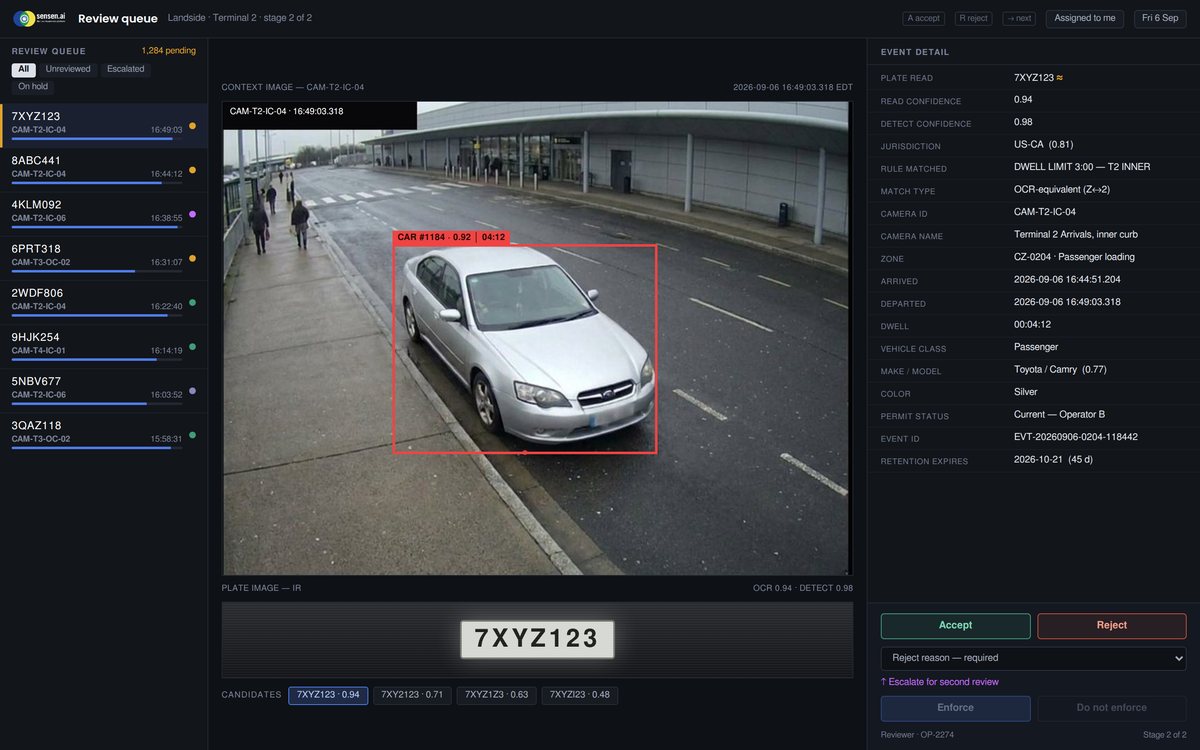
Overstay enforcement is often treated as one of the simplest aspects of parking management. A vehicle arrives, time passes, and if the limit is exceeded, an infringement is issued. On paper, the logic is clean. In practice, it is one of the most fragile enforcement tasks councils manage.
Across Australian cities, overstay infringements consistently generate a disproportionate share of appeals, withdrawn notices, and internal review efforts. This is not because drivers are more inclined to dispute overstays, nor because officers are inconsistent. This is because Overstay enforcement depends entirely on proving duration, and many digital chalking systems were never designed to do so with certainty. SenSen’s parking enforcement software addresses this directly, combining centimetre-level GPS accuracy with multi-angle evidence capture to build a legally defensible, time-stamped record of every overstay event.
Digital chalking replaced physical tyre chalk to improve efficiency and consistency. While it solved visible problems, it introduced a less obvious risk: invisible assumptions. These assumptions rarely surface during daily operations. They appear later, when evidence is challenged.

What Digital Chalking Is Supposed to Do
At its core, digital chalking exists to establish how long a vehicle has remained parked in a regulated space. Most systems use license plate recognition to record a first observation, then attempt to match that vehicle on a later pass to calculate elapsed time.
In theory, this is straightforward. In reality, it only works if the system can conclusively prove three things:
- The same vehicle was observed both times
- The vehicle remained within the same regulated space
- The duration between observations is accurate and uninterrupted
This requirement for continuity makes overstay enforcement fundamentally different from permit or payment validation, which are largely binary checks.
Why Overstay Enforcement Is Uniquely Fragile
Overstay enforcement relies on continuity rather than a single point of truth. Any break in the chain – uncertainty in location, timing, or vehicle continuity – weakens the entire case.
Many systems treat these uncertainties as acceptable operational trade-offs: GPS variance of a few metres, timestamps captured independently from location, plate matches assumed to represent a continuous event. A more reliable approach pairs enforcement with continuous curbside occupancy monitoring, which tracks dwell time from first arrival rather than relying on matched pass observations.
These shortcuts may be operationally convenient, but they do not stand up well under scrutiny. Appeals officers and adjudicators are not looking for sophisticated technology. They are looking for certainty.
When duration cannot be proven cleanly and without explanation, enforcement credibility erodes.
Where Most Digital Chalking Systems Break Down
The most common failure point is the separation of time and location. Many systems record accurate timestamps but loosely associate them with approximate GPS data. In dense urban environments, this variance can span multiple bays or cross into adjacent zones.
Another weakness lies in how continuity is inferred. Many solutions assume that a matching licence plate in the same general area represents the same parking event. That assumption collapses if a vehicle briefly leaves, relocates within a block, or re-enters the zone.
Finally, weak systems push uncertainty downstream. Officers are asked to trust alerts without understanding how confidence was calculated. Back-office teams are left to interpret data and reconstruct timelines after the fact.
At that point, the technology has already failed its primary purpose.
Why These Issues Surface Late
Digital chalking failures rarely announce themselves early. The system continues to operate. Infringements are issued. Compliance appears stable.
The warning signs are subtle:
- Officers hesitate before enforcing overstays
- Back-office teams spend more time reviewing cases
- Appeal success rates quietly increase
Over time, officers avoid overstay enforcement altogether using these tools, not due to policy, but due to lack of confidence in the evidence. Revenue forecasting becomes unreliable. Administrative overhead increases.
By the time these patterns are recognised, enforcement credibility has already been compromised.
What Credible Digital Chalking Requires
Credible digital chalking starts with a simple premise: if duration cannot be proven with confidence, enforcement should not proceed.
That requires time and location to be captured as a single, inseparable record, not as separate attributes linked later. Each observation must be spatially verified, not inferred.
Equally important, the system must be designed to withhold enforcement when confidence is low. Preventing weak cases is not a failure of automation. It is the foundation of defensible enforcement.
How SenFORCE RDK Approaches Digital Chalking Differently
SenFORCE Rapid Deployment Kit (RDK) is designed specifically to address the fragility of overstay enforcement.
Using city-approved smartphones, each scan captures time and location together, creating a verified observation rather than an inferred one. Multiple passes are digitally linked into a single evidence trail, not stitched together after the fact.
When continuity cannot be established with confidence, enforcement does not proceed. Officers are not asked to interpret system logic or justify uncertainty. The data stands on its own.
This approach shifts digital chalking from assumption-based automation to evidence-led enforcement.
The Operational Impact
When overstay evidence is credible, behaviour changes across the operation.
Officers enforce with confidence rather than hesitation. Back-office teams spend less time reviewing cases. Appeals are resolved faster, with fewer withdrawals.
Digital chalking stops being a source of friction and becomes a stabilising force within the enforcement program.
If It Can’t Be Proven, It Shouldn’t Be Enforced
Overstay enforcement does not fail because it is complex. It fails when systems treat assumptions as evidence.
Digital chalking delivers value only when the chain of proof is unbroken. The goal is not more infringements. It is enforcement that stands quietly and consistently when questioned.