The Smart City promise was efficiency. What it delivered, in many cases, was complexity without the tools to manage it. What’s been missing isn’t more infrastructure. It’s intelligence—specifically, the kind of automated, defensible, scalable compliance that the financial sector calls RegTech.
For more than a decade, cities have poured money into “smart” infrastructure. Sensor networks, cameras, connected vehicles, digital permits, indeed the whole apparatus of the data-driven city, is now firmly in place. And yet, for many councils and agencies, the result has been oddly unsatisfying: more data than ever, but not much more clarity.
This is the gap that platforms like SenSen’s are now designed to fill.
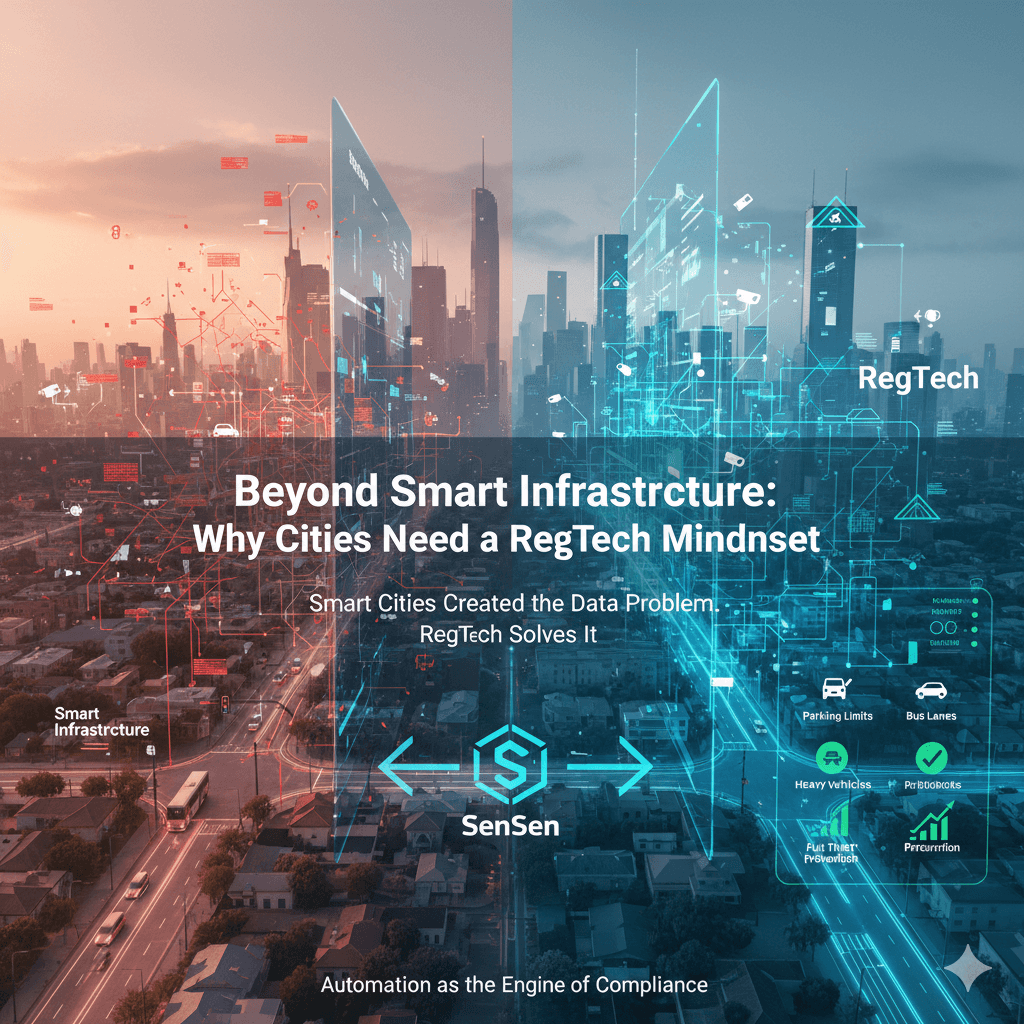
Smart Cities Created the Data Problem. RegTech Solves It.
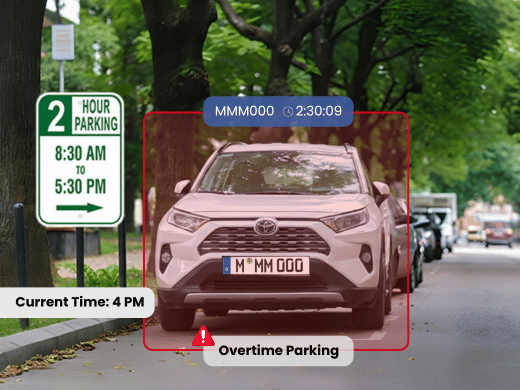
A city’s operations run on rules. Parking limits, loading windows, bus lane restrictions, heavy-vehicle requirements, airport protocols, fuel theft prevention, and more. There are thousands of regulations that exist to protect residents, create fairness, and keep traffic moving. Enforcing them has always been laborious and inconsistent.
Smart infrastructure helped capture what was happening on the ground. But without a mechanism to automate policy enforcement and fuse data from multiple sources, cities remained stuck with fragmented workflows and patchy outcomes.
Financial services hit the same wall. Before RegTech transformed compliance, teams manually screened transactions, interpreted regulations, and reviewed suspicious activity. The processes were slow, error-prone, and impossible to scale. RegTech emerged to automate and orchestrate these workflows by monitoring risk continuously, enforcing rules systematically, and producing audit-ready evidence trails. According to McKinsey, the industry’s growth has been driven by the need to reduce human error, enhance monitoring, and generate predictive insights into compliance trends.
Urban environments are now facing the same inflection point.
Why This Matters for Urban Governance
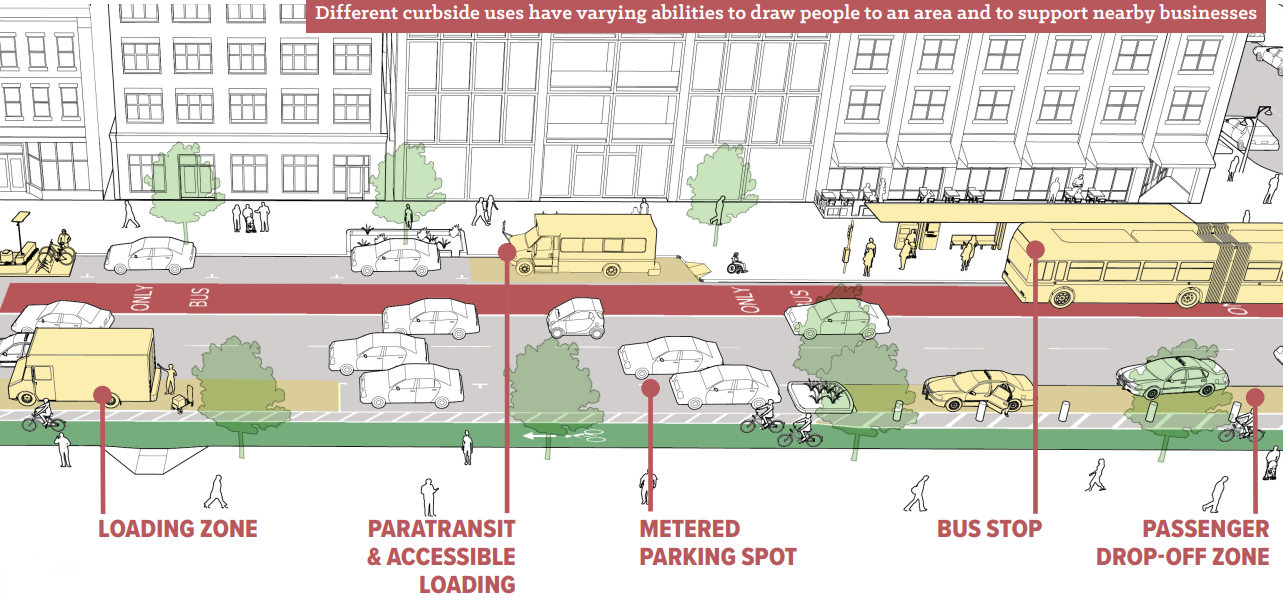
Urban regulation has grown far more complex than traffic signs and parking meters. Cities now manage congested curb zones with conflicting demands, increasingly dense urban cores, rising numbers of ride-hail and delivery vehicles, safety expectations for heavy vehicles, and security requirements at airports, ports, universities, and retail precincts. Public scrutiny around fairness and transparency has intensified.
Traditional enforcement methods using clipboards, manual patrols, and partially automated systems, simply cannot keep pace. The resulting inconsistencies undermine public trust and reduce regulatory effectiveness.
RegTech reframes the problem. It gives cities tools to monitor compliance continuously rather than through periodic checks, automate evidence collection and decisioning, enforce rules consistently regardless of personnel or workload, identify trends and hotspots to improve planning, and produce defensible audit trails that hold up to appeals and legal challenge.
Understood this way, RegTech isn’t an add-on to Smart City systems. It’s the operational backbone that was always missing.
SenDISA: A Purpose-Built Urban RegTech Platform
SenSen’s technology is best understood through this lens. SenDISA, the company’s multi-sensor data fusion engine, ingests video, sensor streams, GPS, enterprise data, and contextual information, then converts them into actionable regulatory insights in real time.
The platform underpins SenSen’s entire product suite: SenFORCE for remote compliance and road safety, SenMAP for curbside regulation and parking enforcement, SenTRACK for video surveillance and forensic investigation, SenSHIELD for fuel theft and retail loss prevention, and SenBLUE for law enforcement intelligence.
Each module applies RegTech principles to a specific regulatory domain. Unlike legacy Smart City providers, SenSen controls the full stack, including the sensors, fusion platform, analytics, and operational workflows, to create a unified enforcement environment that mirrors the end-to-end architecture of modern RegTech systems.
Automation as the Engine of Compliance
The operative word here is automation. Cities adopting SenFORCE or SenMAP aren’t digitising old processes; they’re replacing fragmented manual tasks with fully automated enforcement cycles. Sensors detect activity, SenDISA fuses images with GPS data, permits, zone maps, and enterprise records, violations are identified automatically, evidence packages are generated, and councils manage outcomes through a unified interface.
This mirrors how RegTech automates fraud detection, anti-money-laundering processes, and regulatory cross-checking in finance. By removing manual touchpoints, automation ensures consistency, reduces costs, and, crucially, increases fairness.
For cities, that translates into safer roads, more efficient curb use, better traffic flow, reduced congestion, and more equitable enforcement outcomes.
Real-Time Regulation, Not Retrospective Reaction
As cities densify and mobility patterns shift, regulatory complexity will only increase. Manual enforcement will become even less viable. RegTech offers a scalable path forward: real-time rule enforcement backed by machine-readable policies, automated decisioning, and continuous monitoring.
SenSen already exemplifies this shift. More than 60 government customers across Australia, North America, and Asia use its solutions for remote compliance and digital kerb management.
Urban regulation is no longer about catching violations after the fact. It’s about maintaining a live, dynamic understanding of how a city functions—and ensuring policy is applied consistently across every street, every hour, every day.
That’s RegTech’s promise. And increasingly, it’s becoming every city’s operational necessity.