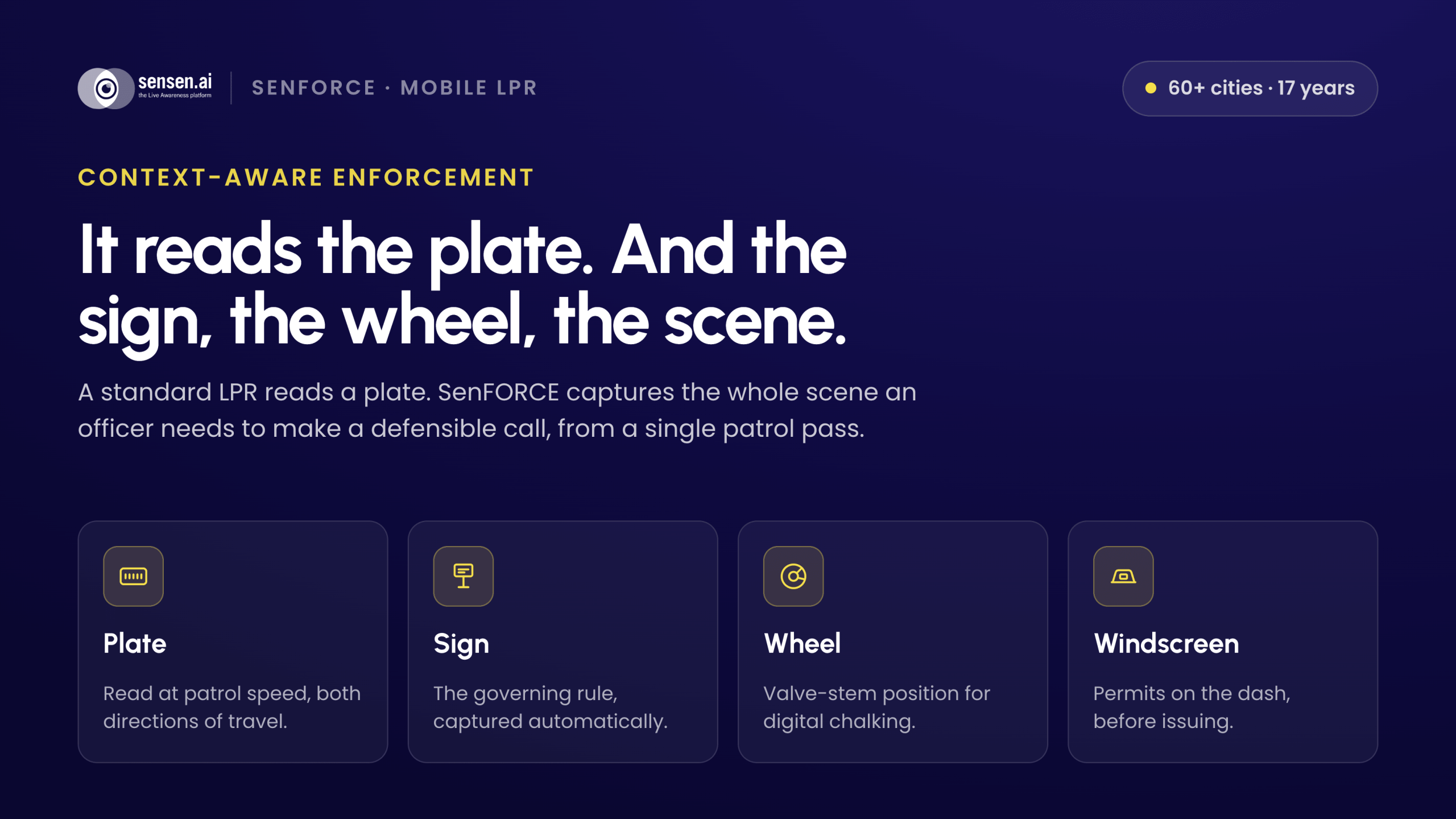
Most LPR systems on the market today were built to do one job well: read a license plate. SenFORCE was built to do the job a parking enforcement officer actually does, which is read the plate, read the sign, read the wheel, read the windscreen, and read the scene. The difference is not the plate read. The difference is what the officer can see when they review the alert.
This article explains what SenFORCE is, how it differs from a standard license plate recognition system, what each camera on the roof captures, how the in-house LPR algorithm works, how the system holds up in GPS-denied zones and underground, and how parking officers use the resulting evidence to make the call. SenFORCE has been deployed for more than 17 years in North America and Australia across 60+ cities.
What is SenFORCE?
SenFORCE is a vehicle-mounted multi-camera LPR system that turns a parking patrol vehicle into an automated city-wide enforcement asset. The system reads plates at patrol speed, matches each vehicle to the rule that governs the block at that time, captures a multi-angle evidence package, and forwards the alert to the officer for review. The officer drives the route. The system handles the detection. Citations issue on the windscreen, on a handheld, or by mail.
The current generation has multiple configurations with 2/4/6/8 camera build. System sees both sides of street simultaneously and dedicates specific cameras to parking signs, vehicle wheels, and license plates. Both builds run on the same back office and the same patented in-house LPR algorithm.
What does SenFORCE do that a standard LPR system doesn’t?
A standard license plate recognition system reads the plate and checks it against a payment or permit list. That is enough for the three core compliance checks (paid, permit, overtime). It is not enough for the whole curb. SenFORCE adds the context that lets a parking enforcement officer make a defensible call on the safety-critical and edge-case rules that share the same block: no-stopping zones, accessibility bays, fire-hydrant clearances, loading zones with differentiated dwell, bus and bike lanes, school-zone variants, and the orientation, position, and behavior rules that traditional LPR cannot see.
What kinds of cameras are used in mobile LPR systems, and which does SenFORCE use?
Three camera types dominate the mobile LPR market. Each produces a different evidence package.
Phone cameras are the cheapest option. A typical setup mounts an Android phone on the dash. The phone runs the LPR locally or through the cloud. The shots are framed around what the dash is willing to show: half-vehicle, half-dashboard, often blocked by anything that passes between the dash and the curb. Battery life is short. Heat in summer is a problem. Read accuracy at any patrol speed above slow is unreliable.
Dedicated LPR cameras are the police-grade option. These cameras are built to do one thing: read a plate. They are often monochrome, often tightly zoomed, often paired with infrared illumination, and almost always run a proprietary LPR algorithm in firmware. When plate rules change (a new digit prefix, a new region code, a new placement), the camera manufacturer issues a firmware update. The image is a plate, not a scene.
CCTV cameras are designed to capture what a person would see, in the lighting conditions a person would see it. They handle wide ranges of light, have multiple zoom levels, and pass full-scene frames to whatever LPR algorithm you bring. SenFORCE uses CCTV cameras because the officer needs to see the scene, not just the plate.
How is SenFORCE mounted on a patrol vehicle, and what does each camera capture?
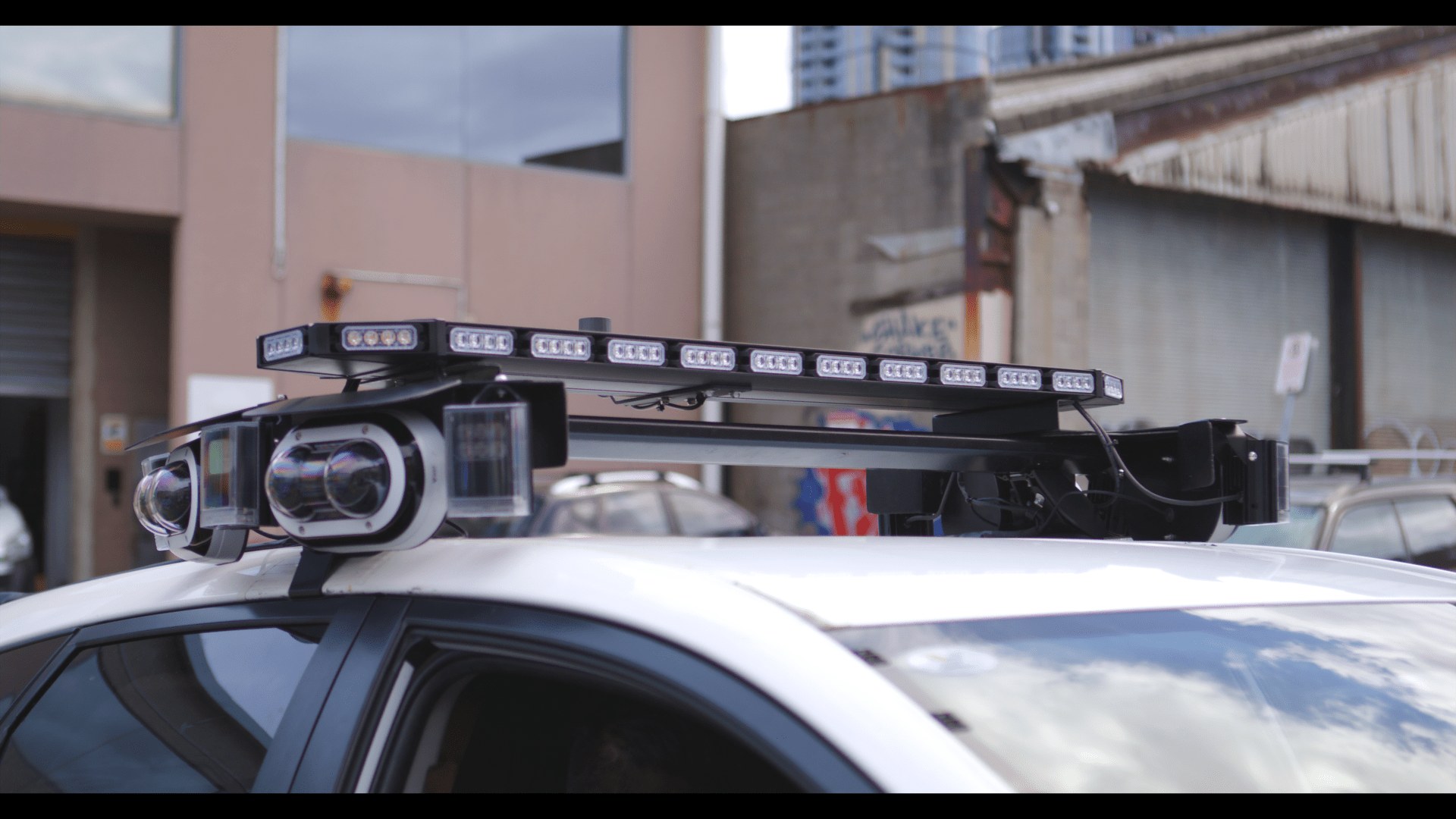
Cameras go on the roof, not on the dash. Roof mounting has two advantages: less obstruction (almost nothing passes between the roof and the curb in normal driving), and better sight lines into the bay. The latest generation runs 2 or 4 to 8 cameras depending on the configuration.
Each camera has a job. Those jobs split as follows:
- License plate cameras capture the plate at speed from both directions of travel
- Sign cameras detect the regulatory sign that governs the bay (paid, time-limited, no-stopping, no-parking, accessibility, loading zone, school zone, and so on). The sign is captured automatically as part of the evidence package; the officer does not need to take a photo of it or pick one from a list
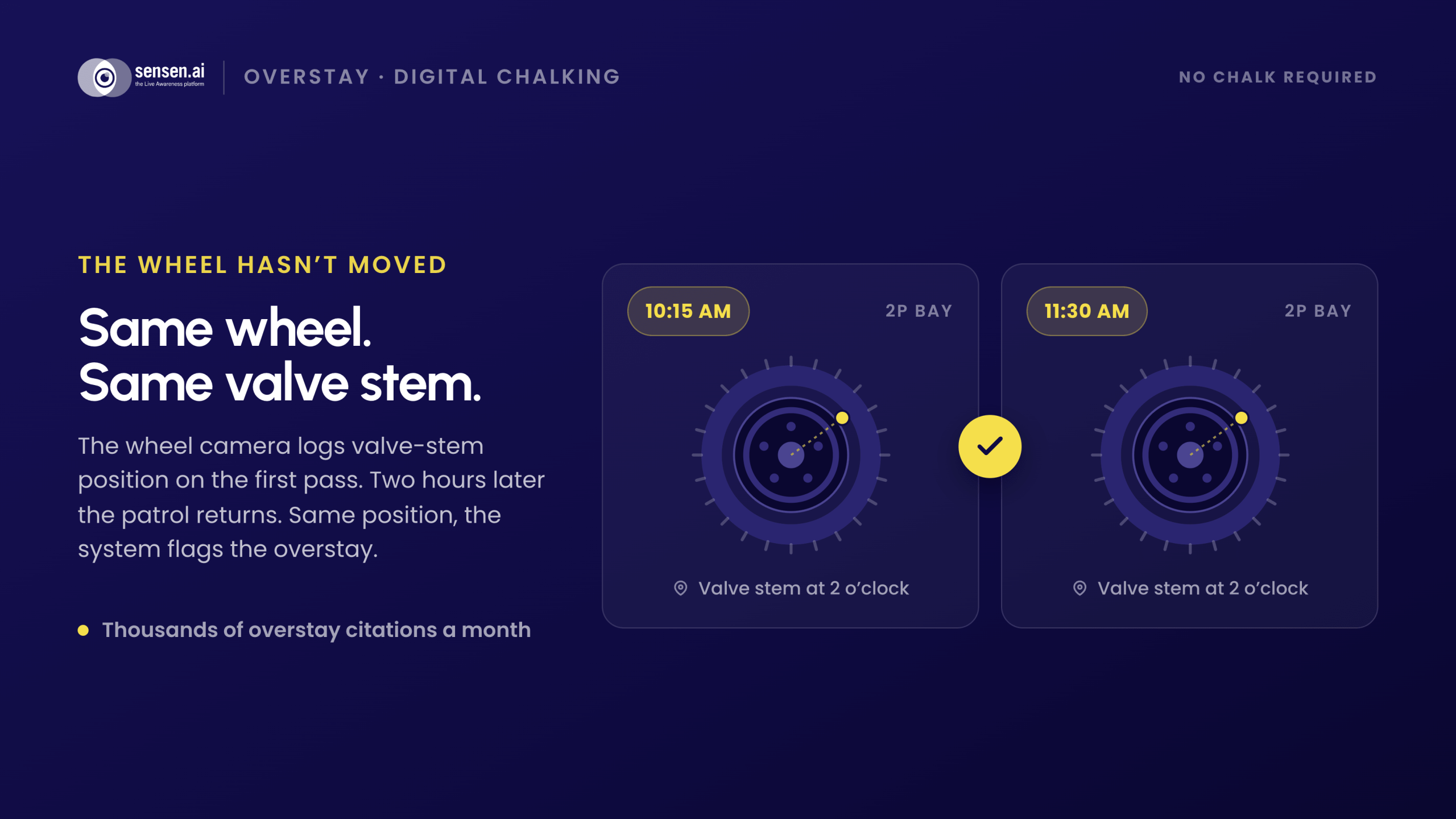
- Wheel cameras capture the wheel and valve-stem position. This is the foundation for accurate overstay detection. If the wheel position at 10:15 a.m. matches the wheel position at 11:30 a.m., the vehicle did not move and the system can confidently flag an overstay. This is the digital equivalent of an officer chalking a tire
- Windscreen / rear cameras capture the windscreen and dashboard so the officer can see permits (mobility, residential, contractor, mobility, loading-zone) on the dash before deciding to issue
The cameras together produce a multi-angle evidence package that holds up on appeal because every angle the officer would need to defend the citation is already captured.
How does SenFORCE in-house LPR algorithm differ from off-the-shelf LPR?
The LPR algorithm matters because plate formats change, lighting conditions vary, and edge cases (covered plates, dirty plates, snowed-over plates, temporary tags, multi-region plates) need to be handled correctly. SenSen has a patented in-house license plate recognition algorithm and a team of computer-vision and AI researchers who maintain it. This matters in four practical ways.
First, when a customer city introduces a new plate format (a new digit, a new prefix, a new region), we update the model in-house. No firmware roundtrip with a camera vendor. No “we will get back to you next quarter.”
Second, the algorithm finds the plate inside the scene first, then reads it. Most off-the-shelf systems run OCR across the whole frame looking for any text that might be a plate. The result is the off-the-shelf approach mistakes street signs, business signage, banners, and bumper stickers for plates. The SenSen approach eliminates most of those false positives at source.
Third, the in-house team can train custom models for whatever a city needs detected. Examples from production: traffic cones placed in a bay to reserve it for a contractor, advertising signs erected without a council permit, abandoned objects in a regulated bay. If the camera can see it, the AI can be trained to detect it.
Fourth, privacy is enforced at source. Faces and pedestrian bodies are blurred in every captured image. License plates of compliant vehicles, the ones that did not break the rule, are also blurred automatically. Only the vehicle attached to the citation is identifiable. The evidence package is safe to publish on a mailed citation or in a resident-facing portal.
How does SenFORCE work where GPS doesn’t?
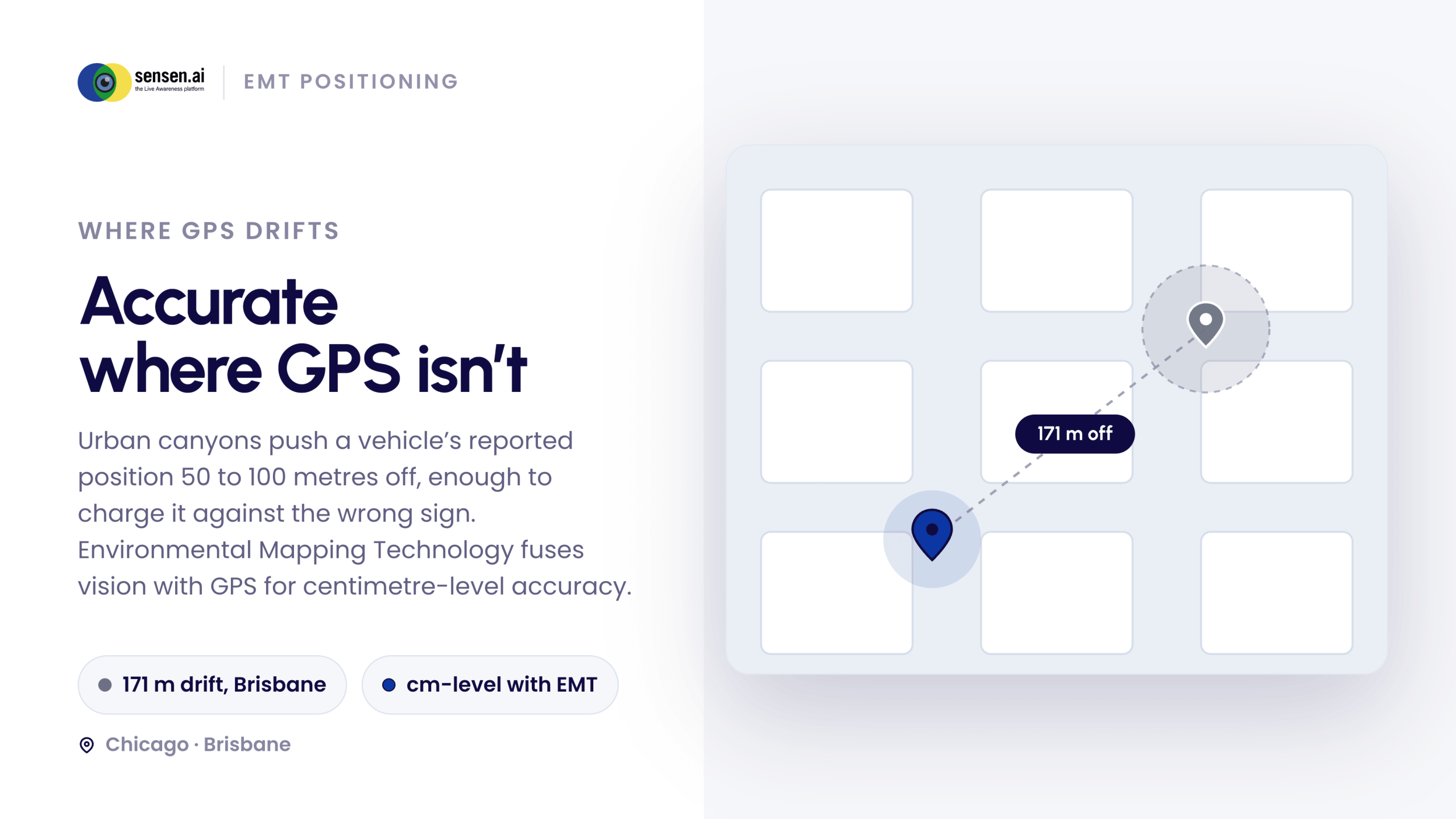
Downtown corridors are GPS-hostile. Tall buildings reflect and block satellite signals, displacing a vehicle’s reported position by tens or even hundreds of metres. In Chicago and Brisbane, urban-canyon displacement of 50 to 100 metres is routine; one Brisbane measurement recorded 171 metres of GPS drift on a downtown corridor. That is enough to put a vehicle on the wrong block, against the wrong sign, in the wrong rule context. GPS alone cannot run accurate parking enforcement in the kinds of dense corridors where parking enforcement matters most.
SenFORCE addresses this with Environmental Mapping Technology (EMT), SenSen’s patented pre–built visual model. The result is centimetre-level position accuracy in GPS-denied corridors, fused with whatever GPS is still available. Chicago and Brisbane are the lead deployments for EMT, and the technology is what makes enforcement on downtown blocks defensible at the zone level.
How does SenFORCE work in underground parking?
Underground garages are a different problem. GPS does not work at all, and EMT cannot work either because most underground garages look the same as every other underground garage. SenFORCE handles this differently. The system runs fully offline (no cloud round-trip required), takes operator input on the active rule set for the garage (“this is a 2P permit zone with this permit list”), captures plates as the officer drives, validates against the payment and permit lists locally, and beeps when a vehicle is detected as non-compliant. The officer issues on the spot or queues the citation for mail. When the vehicle leaves the garage and reconnects, queued alerts upload to the back office for review.
How does officers use the SenFORCE evidence to make a call?
The system surfaces the alert. The officer makes the call. Four real-world examples from customer deployments illustrate how the multi-angle evidence supports the decision.
Accessibility-bay enforcement. A vehicle parks in a designated accessibility bay. The sign camera captures the bay marking. The rear/windscreen camera captures the dash. The officer reviews the dash shot and sees what looks like an accessibility permit displayed on the dash. The officer elects not to issue, because the visible permit means the vehicle is likely entitled to the bay. Without the dash shot, the citation goes out and the appeal succeeds.
Broken-down vehicle. A vehicle is parked in a no-stopping zone. Hazard lights are on. The side camera captures no driver in the seat. The wide context shot captures people sitting on the curb beside the vehicle, with automatic masking applied so they are not identifiable. The officer reads the scene as a breakdown, not a violation, and elects not to issue. The decision is defensible because the evidence shows the scene.
Night-time no-stopping breach. A vehicle is parked in a no-stopping zone after dark. The cameras include an optimized infrared mode that captures a readable plate and a clear front-and-rear context shot. A bystander on a bench is automatically masked. The officer reviews, confirms the no-stopping breach, and issues. The night accuracy is what makes overnight and twilight enforcement viable.
Overstay (digital chalking). A vehicle is parked in a 2-hour bay at 10:15 a.m. The sign camera captures the 2-hour sign. The wheel camera captures the wheel and valve-stem position. The system records the timestamp and the location. Two hours later, the patrol vehicle passes the same block. The cameras capture the same plate, the same wheel, the same valve-stem position. The system flags the overstay. The officer reviews both wheel shots side by side, confirms the vehicle has not moved, and issues. Customers running this workflow issue thousands of overstay citations per month with high success rates on appeal.
How does sign capture support consistent enforcement?
Every SenFORCE detection includes the governing sign as part of the evidence package, automatically. That has two consequences beyond the individual citation.
First, the city ends up with a current curb-asset inventory as a byproduct of the patrol. Signs that have been changed, removed, or installed since the rule library was last updated are visible in the data. Toronto uses this capability to keep its enforcement-zone library current: when a sign changes on the street, the next patrol pass captures the change, and the zone update flows back into the enforcement workflow.
Second, the evidence pack always names the sign the citation was issued against. Appeals that turn on “the sign was different from what the system claims” are decided by the photo of the sign, not by adjudication of competing recollections.
How does SenFORCE work with handheld devices and officers on foot?
Mobile LPR does not replace officers on foot. Most customer cities run a hybrid model where SenFORCE patrol vehicles cover the broad network, and officers on foot or on handheld devices or pole insertable model handle specific corridors, events, and customer-service-led zones. Two patterns are common.
Drivers and chasers. A city like Vancouver runs roughly 15 patrol vehicles with drivers, and pairs each vehicle with officers on foot using a handheld guidance module. As the patrol vehicle detects a non-compliant vehicle, a pin drops on the foot officer’s handheld map, with a photo and the rule context pre-filled. The officer walks around the corner, confirms the vehicle is the right one, clicks issue, and the printer produces the windscreen ticket. Highly efficient because the foot officer does not patrol; they intercept.
Driver plus pull-over handheld issuance. In other cities, the driver of the patrol vehicle responds to alerts that beep on the in-vehicle dashboard. The driver pulls the vehicle over safely, takes the handheld, walks back to the vehicle, places the windscreen ticket, returns to the patrol vehicle, and resumes the route. No chalking required. The system does the digital chalking; the officer handles the human-facing issuance.
Both patterns integrate with the citation and handheld ecosystem cities already run, so the workflow plugs into existing back-office systems rather than replacing them.
How does SenFORCE handle privacy?
Privacy is enforced at source, in three layers. Faces and pedestrian bodies are blurred automatically before the image leaves the camera. License plates of compliant vehicles (the ones that did not break the rule) are blurred. Only the vehicle attached to the citation is identifiable.
The result is that the captured images are safe to publish on the mailed citation, in the resident-facing portal where the recipient reviews the case, and in the back-office review tool the officer uses. The city does not need to redact images manually. The privacy treatment is built into the pipeline.
Where does this go next for US cities?
The shift underneath all of the above is the same. Mobile LPR is moving from a plate-reading function to a context-aware enforcement layer that supports the call the officer has to make. The cities that have made the move are running with fewer appeals, more coverage, and a current curb inventory they did not have to build separately.
For a parking director evaluating an LPR system, the question is not whether to deploy LPR. It is which LPR system will give the officer team enough context to make defensible calls at scale, and enough flexibility to adapt to the city’s plate formats, rule library, and edge cases as they evolve. SenFORCE is built for that question.
See how SenFORCE reads the plate, the sign, the wheel, and the scene from a single patrol pass. Read the curb intelligence use case, explore SenFORCE, or talk to our team.
Frequently asked questions
What is SenFORCE?
SenFORCE is a vehicle-mounted multi-camera LPR system for parking enforcement. The system uses 4 to 8 CCTV cameras on the roof, an in-house patented license plate recognition algorithm, and Environmental Mapping Technology for accurate positioning in GPS-denied zones. It is deployed across North America and Australia, with more than 10 years in production.
How is SenFORCE different from a standard LPR system?
A standard LPR system reads the plate and checks it against a payment or permit list. SenFORCE reads the plate, the sign, the wheel, the windscreen, and the scene on a single patrol pass. The additional context lets parking enforcement officers make defensible calls on no-stopping zones, accessibility bays, fire hydrants, loading zones, school zones, and the orientation and behavior rules that traditional LPR cannot see.
Why does SenFORCE use CCTV cameras instead of dedicated LPR cameras?
Because the officer needs to see the scene, not just the plate. CCTV cameras handle wide ranges of light, support multiple zoom levels, and pass full-scene frames to the LPR algorithm. Dedicated LPR cameras are tightly zoomed and often monochrome; they read plates well but provide little context for the call.
How does SenFORCE detect overstays?
Through digital chalking. The wheel camera captures the wheel and valve-stem position at the first detection. Two hours later (or whatever the time limit is), the patrol passes again, captures the same wheel position, and the system flags the overstay. The officer reviews both shots side by side before issuing.
How does SenFORCE handle underground parking?
Offline. The system runs without cloud connectivity, takes operator input on the active rule set for the garage, captures plates as the officer drives, validates against the payment and permit lists locally, and beeps when a vehicle is detected as non-compliant. Queued alerts upload when the patrol vehicle reconnects.
Is SenFORCE compatible with handheld devices and on-foot enforcement?
Yes. Most customer cities run a hybrid model: SenFORCE patrol vehicles cover the broad network, and officers on handhelds handle specific corridors and customer-service zones. Common patterns include the drivers-and-chasers model (Vancouver) and the driver-plus-handheld-issuance model. The system integrates with the citation and handheld ecosystem cities already run.
How is privacy protected?
Faces and pedestrian bodies are blurred at source. License plates of compliant vehicles are blurred automatically. Only the vehicle attached to the citation is identifiable, which is what makes the captured images safe to publish on mailed citations and in resident-facing portals.